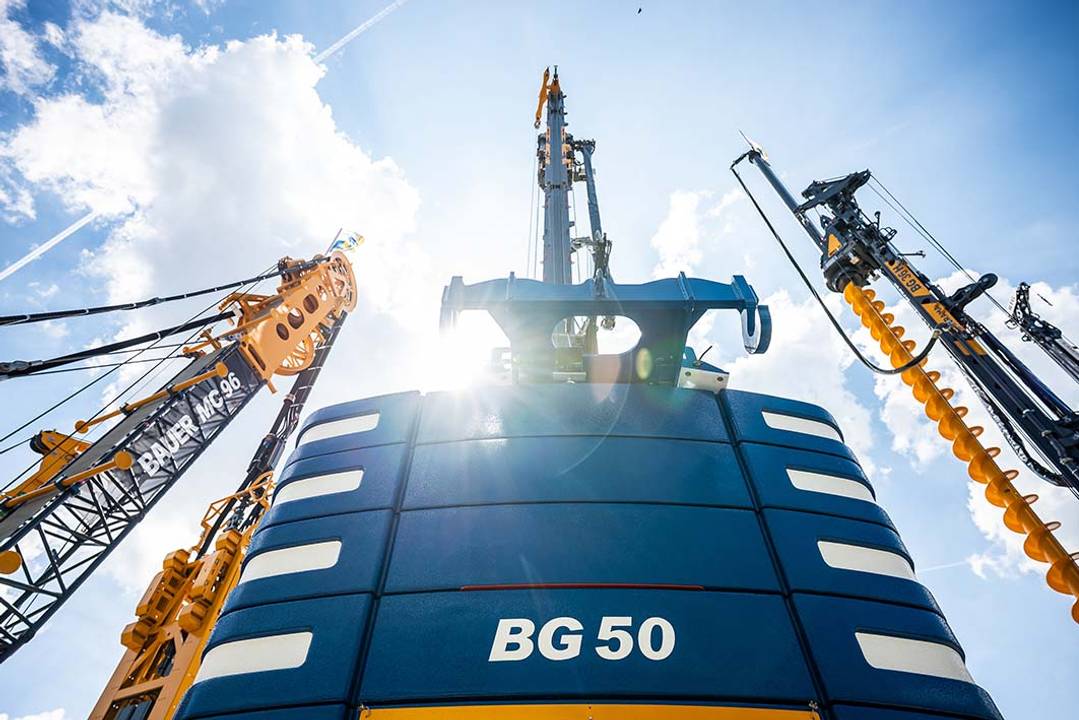
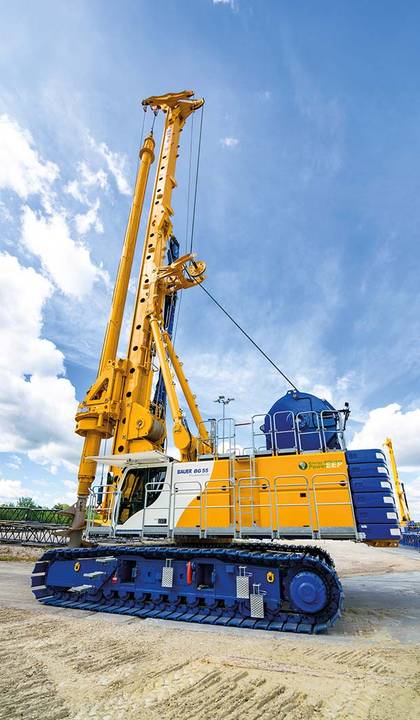
In April this year, Bauer Maschinen GmbH unveiled the new BG 50 rotary drilling rig as the successor to the BG 45. Built on the new Bauer BT 145 carrier and equipped with a service platform integrated into all BT carriers, the BG 50 offers significant advantages in terms of productivity, cost efficiency, safety and reliability on the jobsite. Key upgrades include higher torque, enhanced drilling performance, and improvements in mobilisation and handling.
Specifically, the single-pass drilling depth has increased by 7% and the main winch pull by 11%. With 470 kW of power, the BG 50 also delivers around 8% more output than its predecessor. “The result is a true powerhouse that delivers outstanding performance even in the most demanding drilling applications,” said Johann Kraxenberger, head of the rotary drilling rigs product line at Bauer Maschinen.
The extended mast allows the rig to be set up without an additional assist crane. This simplifies mobilisation and demobilisation, reduces logistics and setup costs, and minimises the space required on the jobsite – an increasingly important factor in urban or confined areas. Particularly noteworthy is that, despite its significantly higher performance compared with the BG 45, the operating weight has remained virtually unchanged.
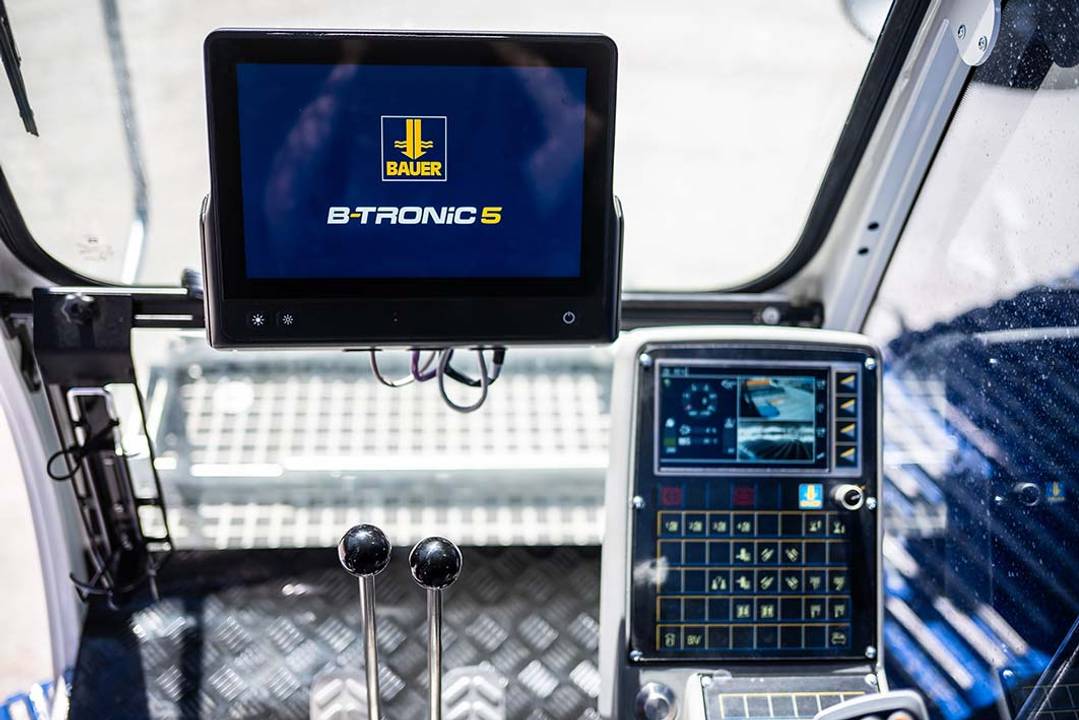
With B-Tronic 5, the BG 50 features a modern, intuitive user interface. Configurable by the operator, the system clearly displays all relevant machine and process data and supports safe and efficient operation. Integrated assistance functions provide direct support during operation.
Before delivery to customers, the BG 50 will undergo an extensive validation and testing programme at Bauer’s Aresing plant in Germany through the end of the year. Under real-world jobsite conditions, the rig’s performance, reliability and safety will be rigorously put to the test. Series production is scheduled to begin in early 2027.
Celebrating 50 years
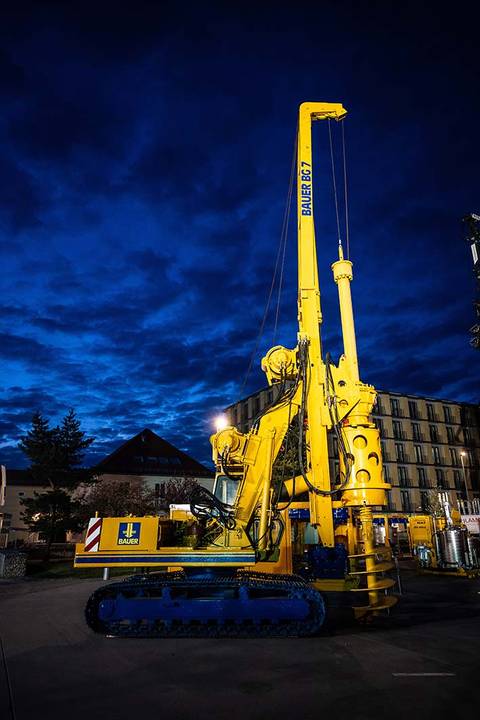
This year, Bauer celebrates the 50th anniversary of its drilling rigs. The company introduced its first model in 1976, the BG 7, which featured a robust mast, a heavy-duty Kelly bar, powerful hydraulics and an innovative cylinder crowd system. Whereas previously it was often possible to complete only two piles per week, the BG 7 was capable of installing several piles per day. Its triple-telescopic Kelly bar enabled drilling depths of up to 18 m and maximum drilling diameters of 1,500 mm.
According to Bauer, the drilling rigs available at the time could no longer meet the growing demands of construction sites. For Dr Karlheinz Bauer, who was then leading the family-owned company in its sixth generation, the answer was clear: “Then we’ll build one ourselves.”
Originally developed for internal use, Bauer’s drilling rigs quickly attracted strong interest from the market. The BG 7 was followed by additional models, such as the BG 11 and BG 22. In 1989, the company unveiled the BG 30 at the bauma exhibition in Munich, featuring a maximum torque of 367 kNm, a crowd force of 350 kN and drilling diameters of up to 2,000 mm.
Today, the Bauer rotary drilling rig portfolio covers a wide range of performance classes, from the compact BG 15 H, with its rear-folding mast, and the electrically powered eBG 33 to the BG 55, equipped with a BTM 720 torque multiplier for cased drilling at greater depths and diameters. At bauma 2025, the company presented its new BTM 600 torque multiplier for cased continuous flight auger (CCFA) applications.
“In the early days, everything in rotary drilling rigs was purely hydraulic – a few levers, a few pressure gauges, and that was basically it,” noted Mr Kraxenberger. “Today, we work with digital interfaces, electric joysticks and live data. The technology has fundamentally changed over the past decades.”
Alongside digitalisation, sustainability and energy efficiency are becoming increasingly important in construction equipment. For years, Bauer has relied on its Energy-Efficient-Power technology (EEP). Among other benefits, it improves overall efficiency, enables energy recovery and optimises auxiliary consumers.
“Thanks to EEP, the fuel consumption of our rotary drilling rigs is reduced by up to 20% – a tangible benefit for both the environment and our customers,” said Mr Kraxenberger. This is complemented by numerous assistance systems, including Stability Plus, the adaptive Kelly retraction assistant, and the Kelly winch Speed Limiter for critical soil conditions. These systems help the machines operate more efficiently and safely while reducing wear on the equipment and conserving resources.
New B-Tronic control system
B-Tronic is used in a wide range of Bauer’s machines, from its rotary drilling rigs and duty-cycle cranes to piling rigs from RTG. The system supports operators during daily operations, automates recurring tasks and provides valuable data for analysis and project planning. Sensors continuously capture operating data, making it available in the cab, on mobile devices and in the office. The result is a seamless flow of information – from work on the ground to project documentation.
To further enhance and expand the system, Bauer has introduced the latest version, B-Tronic 5. Developed specifically for rotary drilling rigs, it focuses on dynamic operation, process support and practical usability for demanding drilling applications.
B-Tronic 5 was developed in close collaboration with experienced equipment operators. Their feedback from real-world jobsites played a decisive role in shaping the system’s structure, operating logic and functionality. The user interface can be individually configured, and functions are tailored to typical operating conditions. The goal is to reduce operator workload and allow users to focus on the drilling process itself.
The dynamic user interface is the highlight of the new control system. Rather than relying on static displays, the system automatically adapts to the current stage of operation. Content and visualisations change dynamically as work progresses through different process phases. User-defined thresholds provide visual feedback whenever deviations occur. This ensures that operators receive exactly the information they need at the moment they need it.
“You’re not working with a rigid screen. The functions are flexible and can be customised to your needs. Many key parameters are calculated automatically, allowing you to focus more on the work itself. At the same time, you can optimise your workflows. That’s why I enjoy working with B-Tronic 5 – no other machine offers that,” said Maik Breuning, equipment operator at Demler Spezialtiefbau GmbH.
In day-to-day operations, clarity matters. B-Tronic 5 presents all relevant machine and process data in a clear, structured format. Messages, functions and guidance are logically organised and quickly accessible. Integrated support tools assist operators directly during operation and are complemented by practical usage tips. This reduces time spent searching for information and simplifies operation, particularly in complex working situations.
Every operator works differently, and B-Tronic 5 reflects that reality. Personal user profiles enable customised work screens tailored to individual preferences. Frequently used functions can be arranged as widgets, creating an operating environment that matches each user’s needs and supports uninterrupted workflows.
“With B-Tronic 5, we have specifically aligned the next stage of development of our machine control system with the requirements of modern rotary drilling rigs. Throughout the development process, our focus remained firmly on the operators and their workflows,” said Franz Harnisch, product manager for drilling rigs at Bauer Maschinen. “At the same time, B-Tronic 4 remains an integral part of our portfolio and will continue to serve as the proven standard solution for our rotary drilling rigs, piling rigs and duty-cycle cranes.”
All images: Bauer Group