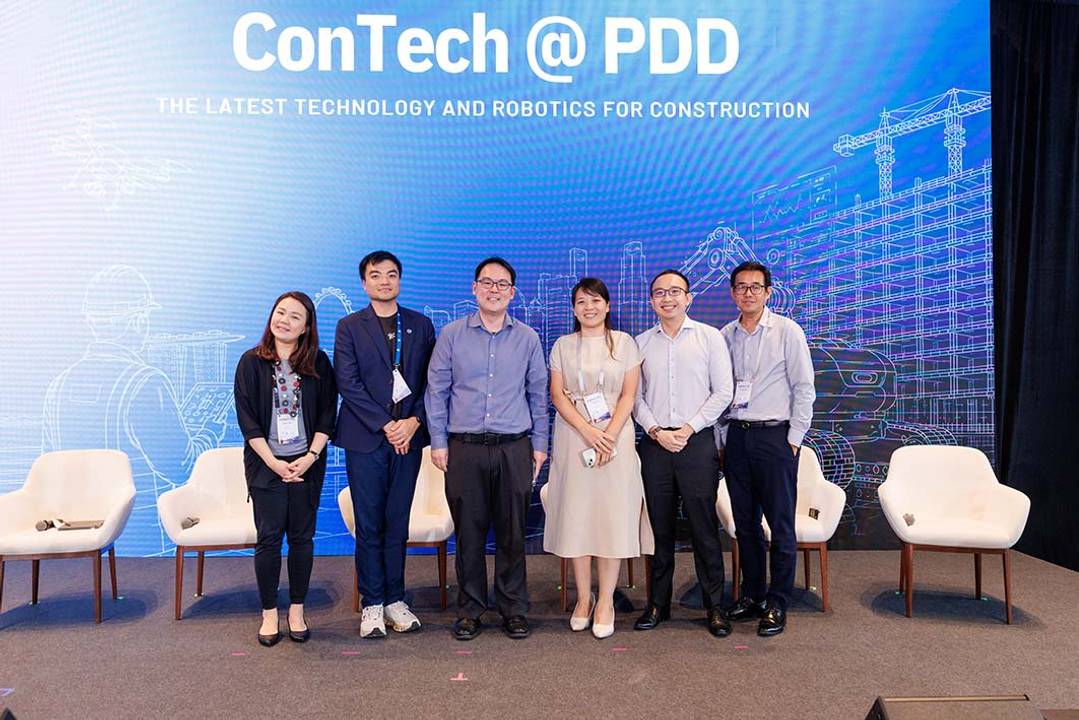
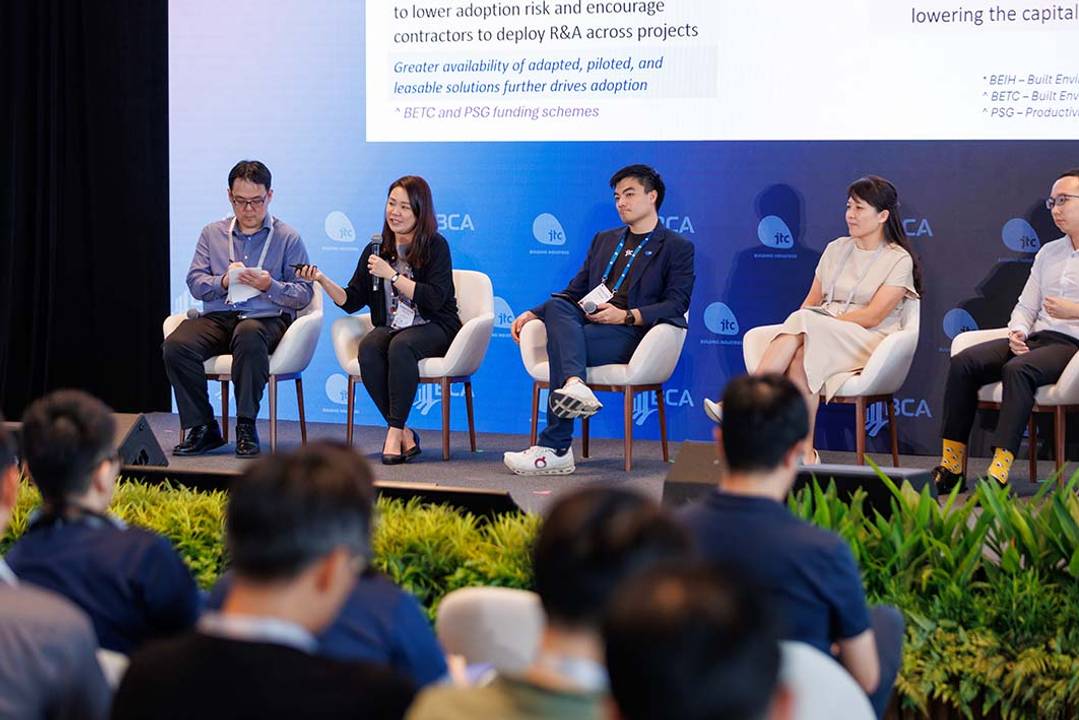

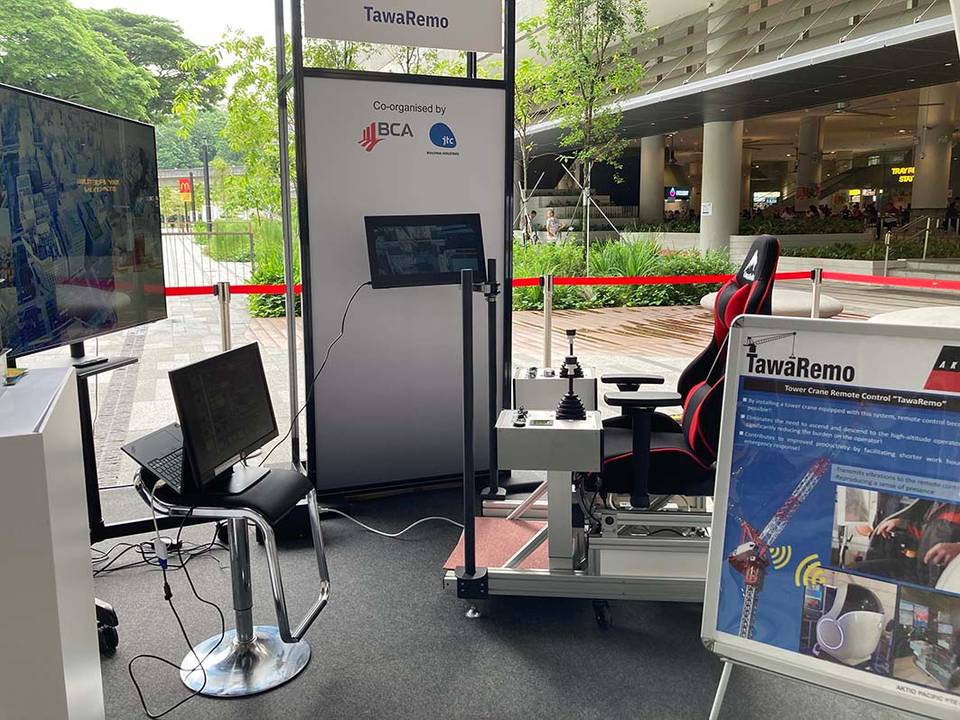
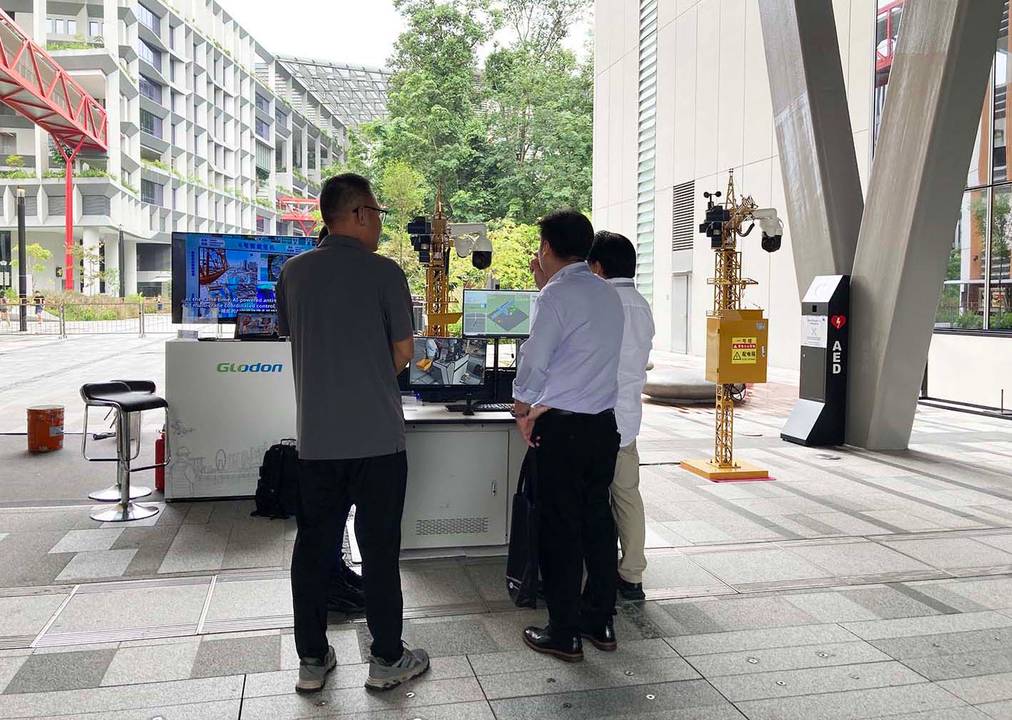
Co-organised by the Building and Construction Authority (BCA) and JTC Corporation, the Construction Technology @ Punggol Digital District (ConTech@PDD), held on 17 July 2026, brought together Singapore’s government agencies and industry stakeholders to share their robotics & automation (R&A) adoption journeys, discuss the challenges and opportunities ahead, and showcase practical solutions. [View the story on contractors and suppliers here.]
Government taking the lead
Could the construction industry one day embrace highly automated solutions that require little or no human presence in its operations? “For us, we believe the answer is yes,” said Cheong Jiawen, director for future of building and infrastructure at JTC.
“We call this vision ‘lights-out construction’ – a future where people no longer work on dirty and dangerous construction sites, but instead direct teams of autonomous machines and robots from the safety and comfort of an air-conditioned control centre. We are not there yet, but every autonomous solution that we test and deploy brings us one step closer to this reality.”
As a leading government agency, JTC “wears many hats,” shared Mr Cheong. Its responsibilities span industrial development, infrastructure and reclamation, as well as the operation of a Centre of Excellence for Buildings and Infrastructure and a Centre of Excellence for Underground Caverns.
Given the scale of these responsibilities, JTC has been actively advancing construction automation solutions together with its partners. Ongoing R&A projects include an autonomous heavy construction equipment trial, CCTV analytics to measure infrastructure site productivity, and automated covered drain inspections.
JTC’s upcoming R&A projects will involve high-reach painting and coating robots, high-reach autoclaved lightweight concrete (ALC) panel installation robots, robotic solutions for construction monitoring and inspection, and remote-controlled tower cranes.
Mr Cheong called for closer collaboration within the industry, emphasising that this would “strengthen not just one or two companies, but the entire built environment ecosystem in Singapore.” His message was clear: “We are all in the same boat, in a sense, and we want people to get on board with us. If you don’t get on board, then be prepared to be left behind.”
Discussing the reasons behind the push for R&A adoption, Sherlyn Chua, deputy director of construction transformation and technology at BCA, explained that the technology helps reduce reliance on manpower, as well as replace or isolate workers performing hazardous tasks, thus lowering potential risks on site.
The R&A technology also enables more precise and optimised material consumption, minimising waste and overuse, while delivering greater consistency in output and thereby reducing rework and errors. Beyond that, it can help attract and retain a younger, tech-savvy workforce.
“But the longer-term benefit is the real cost savings for your business,” said Ms Chua.
So far, approximately 30 R&A solutions have been adopted across 70 projects by 50 firms in Singapore for architectural, structural and M&E works, among others. These solutions include smart hoists and various robots for concrete finishing, tile grouting, floor tiling, welding, rebar tying, drilling and anchoring, floor screeding, and more.
Ms Chua highlighted some successful R&A applications and their return on investment (ROI), based on current data collected from users. “Take, for example, the painting robots. One machine can help replace up to 80% of manual work and operates about 2.5 times faster.
“From a business ROI perspective, the payback period is roughly six to seven years. With a 50-70% grant, this can be shortened to two to three years. We are seeing similar results for concrete levelling robots and tile grouting robots.”
A concrete levelling robot can operate up to four times faster than manual methods, with a payback period of 0.3–0.5 years when supported by a 50–70% grant. Meanwhile, a tile grouting robot can complete work up to five times faster than manual methods, with a payback period of 1.1–1.8 years under the same level of grant support.
“The measure is really the government specifying R&A in its projects,” said Ms Chua. “This creates demand and tells investors and solution providers that there is a real market here.”
Making R&A adoption easier
To further drive R&A adoption, BCA provides a sandbox where companies can test, iterate and scale new technologies. Since 2023, the facility has hosted more than 170 technology demonstrations and testbeds, including about 60 R&A solutions. [View the earlier announcement here.]
Another government initiative is to streamline regulatory requirements in collaboration with the Ministry of Manpower (MOM). For example, the two agencies recently granted exemptions to the first batch of projects, allowing them to operate smart hoists without an operator.
From MOM’s point of view, the main objective is to “protect our mission, which is to ensure that with the adoption of any new solutions, such as R&A, or innovative methods of doing things, the workplace remains safe,” said Bernard Kwok, senior deputy director of engineering safety at MOM.
“Is there a new risk? Is there a risk that we didn’t foresee initially? How do we mitigate that? How do we change the way we work to make it equally safe?” That’s one area where MOM, as the safety regulator, comes in.
The second area, as Mr Kwok pointed out, concerns regulatory hurdles. “We recognise that with the adoption of these technologies, there are certain rules and regulations that could slow you down, and at times even stop you from implementing certain methods. Do let us know, and we will find a way around them.”
Mr Kwok reiterated that the regulator supports the industry’s transformation, particularly efforts to enhance workplace safety. Ultimately, “a safer worksite will lead to higher productivity, less downtime, and lower costs arising from accidents.”
‘Don’t wait for a perfect solution’
“R&A is no longer an option; we see it as a very important enabler in meeting all these higher expectations,” said Yang Xue, director of rail expansion civil team 3 and lean office at Land Transport Authority (LTA), adding that the technology “matters” because of “workforce constraints, safety priorities, productivity imperatives and the sustainability drive. It has transformed the way infrastructure is delivered.”
LTA began its R&A journey in 2017, working with contractors and vendors on infrastructure projects, such as tunnelling works. To date, the solutions deployed include a robotic arm for steel ring installation, concrete levelling robots, hydro-demolition robots, robotic shotcrete machines, tunnel profile scanning, painting robots, ALC robots and plastering robots, among others.
However, “having technology on-site is not enough,” noted Ms Xue. “Deployment means integrating it into daily workflows, training teams and adapting processes to fully realise its value.” She continued, “Successful adoption requires redesigning workflows by aligning responsibilities, timelines and quality checkpoints to leverage new capabilities.”
As LTA expands the use of R&A technology across its infrastructure projects, the authority is also setting increasingly higher standards for its solutions. Ms Xue advised industry players: “Don’t wait for a perfect solution, because every scalable deployment starts from a simple trial.”
Jeremy Keck, deputy director of building technology and automation research at Housing and Development Board (HDB), reaffirmed the board’s target of achieving a 40% improvement in on-site productivity by 2030 through precast design standardisation, digitalisation and R&A solutions.
On the R&A front, HDB has set up a taskforce that aims to identify construction work areas with R&A potential; deploy commercial solutions or develop research solutions; identify and apply robot-oriented design guidelines to improve robot deployment; and share knowledge to facilitate R&A adoption.
The growing number of public housing projects in Singapore presents significant market opportunities for R&A industry players. According to Mr Keck, technologies in the pipeline include robots for floor concreting, floor screeding and pile marking, as well as smart hoists.
All players are welcome. HDB does not rely on a single partner, said Mr Keck. “If we put all our eggs in one basket, then there’s a lot of risk that we’re taking. In some ways, we need to build an ecosystem of similar solutions, similar functions.”
For example, HDB currently has six vendors for its painting robots. “We went through all six of them, looking at their capabilities and functions, and made sure that we set our requirements fairly so that everybody, or most of them, could come on board, “ he explained.
“We need to build an ecosystem such that, when the time is right, we can start to scale up and set the bar higher.”
The opportunities are also open to businesses of varying sizes. “We are not here to favour the bigger players over the smaller ones. That has never been our intention,” stressed Mr Keck. “No matter how big or how small you are, as long as you are willing to partner with us, we will be there for everyone.”
Image credits:
Images 1-2: JTC