

Singapore’s Technology Exchange on Workplace Safety and Heat Resilience Solutions took place on 22 May 2026 at the Built Environment Innovation Hub (BEIH), BCA Braddell Campus. Organised by the Building and Construction Authority (BCA), the event brought together government agencies, BE industry stakeholders and solution providers to explore practical, scalable innovations that can protect workers while keeping jobsites running efficiently
The Ministry of Sustainability and the Environment (MSE) has designated 2026 as the Year of Climate Adaptation in Singapore. This designation is highly appropriate and, along with the new Heat Resilience Policy Office, reflects the importance of heat resilience efforts, said Jonathan Cheng, chief technological officer and group director (Built Environment Technological Alliance & Built Environment Research and Innovation Institute) of BCA, in his opening remarks.
Mr Cheng pointed out that heat resilience is a major issue for the construction industry, given the vulnerability of on-site workers to heat-related risks. It is increasingly challenging to work outdoors since the weather becomes “hotter and more uncomfortable,” he noted. “This leads to a lot of concerns on our end, whether it’s the loss of productivity or, in the worst case, even loss of lives, which we have seen.”
With that in mind, Mr Cheng called on firms to look after their workers’ welfare and stressed that keeping them safe and well is essential to maintaining productivity and, in turn, completing projects on time.
Cooling apparel
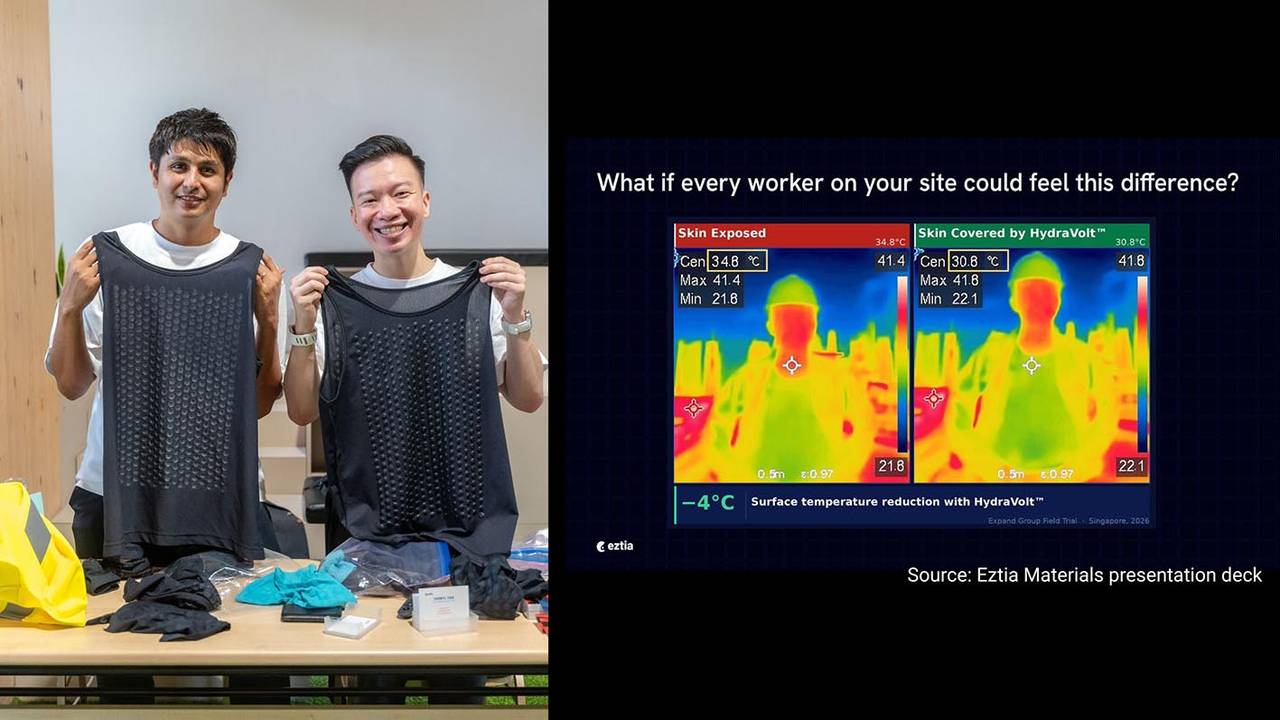
One of the innovative solutions presented at the event was the HydraVolt hydrogel platform, a cooling technology developed by Eztia Materials and suitable for field, industrial and outdoor use.
The technology is “applied as a dot matrix of engineered microstructures directly onto garments, PPE and uniforms,” shared Darryl Tan, APAC go-to-market lead at Eztia Materials. “The microstructures enable consistent relief in high humidity conditions.”
HydraVolt absorbs body heat, allowing the skin surface temperature to be reduced by up to 9°C in less than three minutes and the cooling effect to be sustained for up to eight hours, explained Mr Tan. The products available with this technology include arm sleeves, bandanas and inner shirts.
Apart from being lightweight and portable, HydraVolt is also electricity-free and simple to use, as it can be recharged using water – for example, by machine-washing or soaking the garments in water.
In his presentation, Mr Tan showed FLIR thermal imaging data from a field trial conducted by contractor Expand Construction, which indicated a 4°C reduction in skin surface temperature with HydraVolt protection.
“The workers said they felt the cooling effect immediately and found it highly comfortable for prolonged wear, with no added bulk,” said Asher Lum, assistant project director at Expand Construction, commenting on the trial results.
According to Mr Lum, Expand was drawn by the “practicality” of HydraVolt, which offers “passive cooling and requires no external power. Therefore, we don’t need to plan for charging infrastructure. It is also lightweight, can be integrated directly into what workers already wear, and is self-sustaining through simple water recharges.”
“Construction sites are already operationally complex environments, so simple solutions are often more sustainable on the ground,” he said, adding that Eztia also acted swiftly on feedback from workers by “removing the sharp, uncomfortable edges; making the textiles lighter and more breathable; and softening the hydrogel interface for continuous wear.”
Expand is now moving into Phase II of the trial and extending this heat protection to its subcontractors.
Mr Lum further elaborated on Expand’s strategy for heat stress management. This includes environmental tracking, with continuous wet-bulb globe temperature (WBGT) monitoring and microclimate data, as well as site regimes comprising a ‘water parade’ to ensure workers stay hydrated, structured work-rest cycles, and dedicated cooling and recovery shelters.
In addition, Expand carries out intensive supervisory monitoring and peer-to-peer site education, and actively explores emerging wearable cooling technologies to bridge gaps where environmental controls cannot reach.
“We remain open-minded and collaborative, as emerging technologies require early adopters willing to test in real-world, messy environments,” explained Mr Lum. “Innovation in construction must ultimately serve the people on the ground.”
AI-powered smartwatch
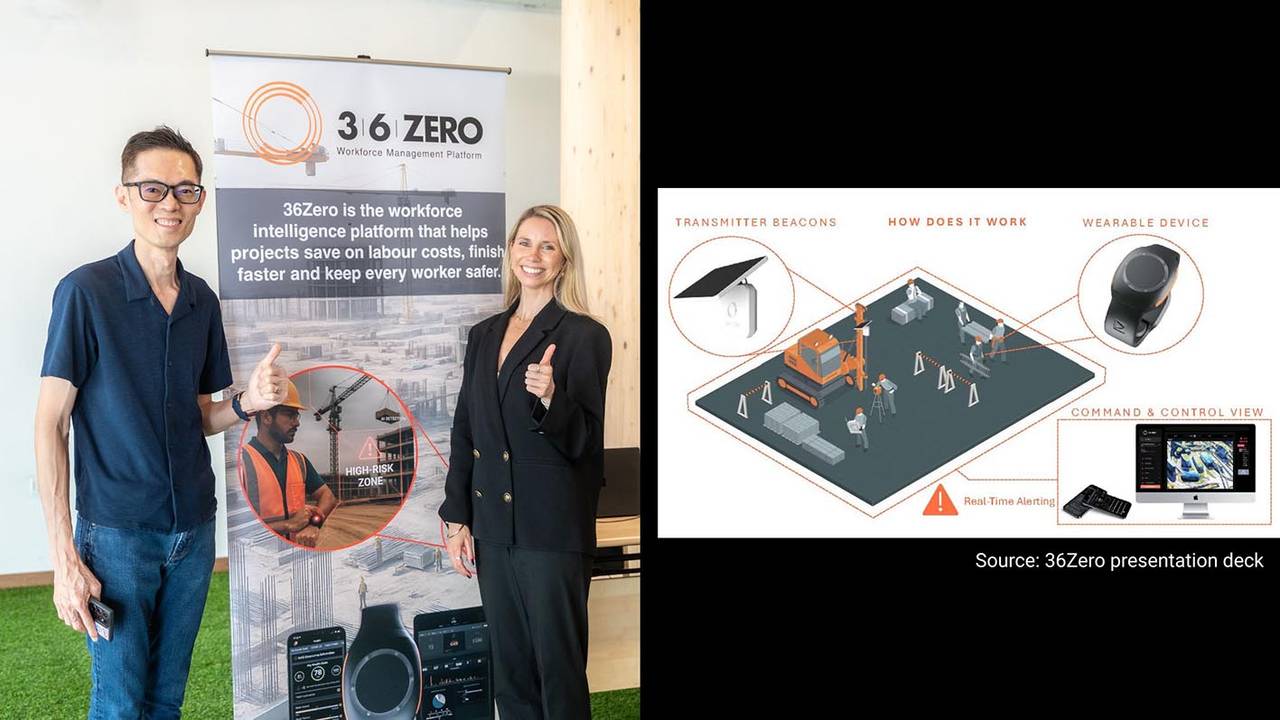
Another innovative solution highlighted was the 36Zero system, an integrated platform that provides a real-time view of worker well-being, safety and jobsite operations.
“It is the only platform in the world designed to manage labour mobilisation, ensure safety and streamline worker welfare, seamlessly integrated into one solution,” said Fiona Carr, client enablement and programme advisory lead at 36Zero. “The system harnesses the power of Al and wearables to revolutionise workforce management.”
The platform incorporates a number of features, including Budy360, a lightweight, user-friendly wearable device that provides location tracking and health monitoring. “It also captures heart rate and, together with the temperature we monitor on site, we’re able to detect early signs of heat stress,” explained Ms Carr.
The data is collected and transmitted via Locate360, a solar-powered secure network sensor. “All this data gets transferred to our command-and-control dashboard through the cloud,” she added, referring to Data360, a SaaS dashboard that displays real-time and reporting views across worker health, safety and site efficiency. “We also have an app that notifies users when incidents or safety alerts occur.”
The 36Zero system is complemented by Health360, a digital health kiosk that can be linked to the 36Zero Health App and integrated with the Budy360 wearable device.
Ms Carr also introduced Bodytrak, which was recently acquired by 36Zero. Designed to prevent workplace incidents caused by fatigue and heat stress, it is believed to be the only non-invasive product of its kind on the market.
Beth Henderson, lead for innovation and commercialisation at The GEAR by Kajima, and Yip Kok Choon, safety manager at Kajima Overseas Asia (Singapore) (KOAS), shared the findings from an on-site trial of the 36Zero system.
Both companies are part of the Kajima group. The GEAR by Kajima aims to translate emerging technology into real-world commercial use, while KOAS is an operational test-bed for innovation and solution implementation.
The team has already established strategies to address heat resilience, but rising temperatures require greater monitoring and additional preventive measures, said Mr Yip. As a result, the 36Zero system was trialled, involving 40 workers from March to April 2026.
The system was chosen for several reasons: it is a preventive heat stress solution that takes proactive measures to improve worker safety; adopts a holistic monitoring approach combining wearables and health kiosks; enables accurate data collection for better-informed decision-making; includes a first-of-its-kind hydration kit; and supports collaborative development, allowing customised features such as hydration integration.
Speaking about worker feedback, Ms Henderson said it was generally positive. All participants reported that “the wearable was comfortable to wear during the day” and they “enjoyed using the health kiosk.”
Among the key learnings from the trial, she noted that “data drives behaviour change, with workers responding positively to personal health insights; location tracking has enhanced both safety and productivity; and wearables, together with medical-grade monitoring, have effectively improved worker health and well-being.”
According to Ms Henderson, the technology enabled the team to identify potential heat stress risks early that may otherwise have gone undetected and to manage them effectively. She added that discussions are currently underway regarding the scope for ongoing deployment.
Leading from the top
Lim Yi Hong, environmental, safety and health (EHS) manager at Teambuild Engineering and Construction, outlined the company’s best practices for heat resilience and worker safety.
Teambuild has put in place a four-pillar heat defence strategy. It starts with ‘top management commitment’, which aims to establish policy and commit organisational resources on site.
“Safety initiatives should not be just on paper, but rather we should turn them into reality, whereby we allocate relevant resources on the ground to drive initiatives across the organisation,” said Mr Lim on the first pillar. He added that the company’s safety policy is reviewed annually and that its CEO participates in key safety programmes.
The second pillar is ‘technological shield and upstream measures’, which focuses on alternative construction methodologies, Al video analytics, and robotic and mechanical aids.
The company’s alternative construction methodologies include the use of 3D modelling to improve visualisation of the construction process and minimise rework, as well as adopting alternative construction methods, such as modular column formwork and a cantilevered balcony support system and platform. Mr Lim said the key objectives are to reduce “the need for workers to carry out manual work and their exposure to high-heat environments.”
Likewise, Teambuild implements AI-powered safety surveillance and detection of potential heat-related injury cases, and employs robotic and mechanical aids – e.g. an intelligent lifting frame and a spray-painting robotic machine – to reduce manual and physical work on site.
The third pillar is ‘on-site heat mitigation measures’, consisting of heat acclimatisation programmes, heat stress protocols, on-site heat stress initiatives and regular training. The final pillar is ‘emergency readiness’, which is achieved through setting up a trained ERT team and conducting drills to familiarise personnel with heat-related emergencies.
Jaime Lim, director of the occupational safety and health (OSH) specialist and major hazards department at the Ministry of Manpower (MOM), stressed that “workplaces have to prepare for a warmer climate, adapt work practices and adopt solutions to mitigate heat stress.”
She cited Singapore’s Third National Climate Change Study (V3), which projects that “very hot days and warm nights will be the new normal by the end of the century” and highlights a “rising threat of heat stress.” In response to increasing temperatures, MOM rolled out its revised framework in 2024 to guide employers and protect outdoor workers from heat stress.
A range of innovative measures has been implemented at the jobsite to enhance worker safety and heat resilience, shared Ms Lim. In construction, for example, besides Eztia’s cooling garments and 36Zero’s workforce management platform, other solutions include APX Technologies’ low-cost real-time WBGT system, an ice slurry machine at a construction site’s rest area, a cool-air refresh pod to help cool outdoor workers, and an AI system that provides workers with early warnings of high heat.
During a panel discussion, Ms Lim urged the industry to look beyond fatality rates when measuring safety performance, emphasising the need for a more “progressive, worker-centric” approach to achieve long-term results. “Instead of counting how many [fatality] cases we have, why not focus on how we can protect and uplift workers and help them perform their jobs better?” she said.
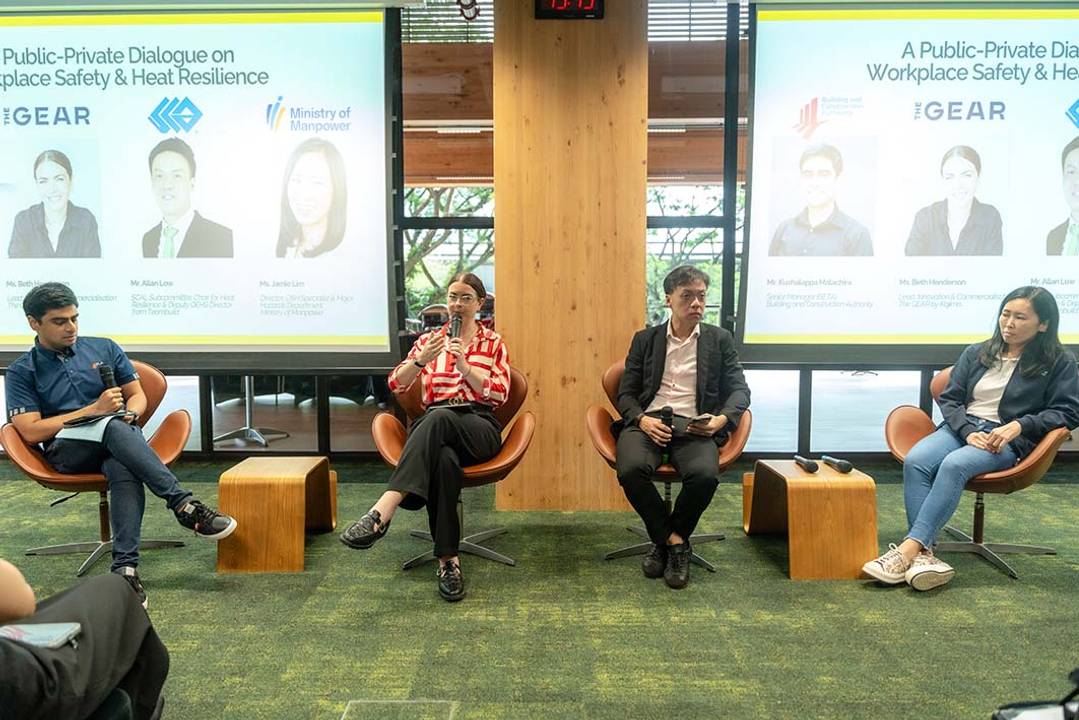
In addition to Ms Lim, the panel discussion comprised Kushalappa Malachira, senior manager of Built Environment Technological Alliance at BCA (moderator); Allan Low, subcommittee chair for heat resilience at Singapore Contractors Association Limited (SCAL) and deputy QEHS director at Teambuild Engineering and Construction; and The GEAR by Kajima’s Ms Henderson.
There was also an exhibition area showcasing a variety of solutions, including: 36Zero; Eztia Materials; Ailytics (AI-powered video surveillance systems for site operations); Invigilo AI (AI-powered video analytics for workplace safety); viAct (AI monitoring systems for workplace safety); and FJDynamics (a robotics company offering smart safety technologies, such as an excavator guidance system and a tower crane lift function).
Image credits:
Event photos in the article: War Studio (via BCA)
Images from presentation slides: Eztia Materials and 36Zero
Event photos in the video: SEAC