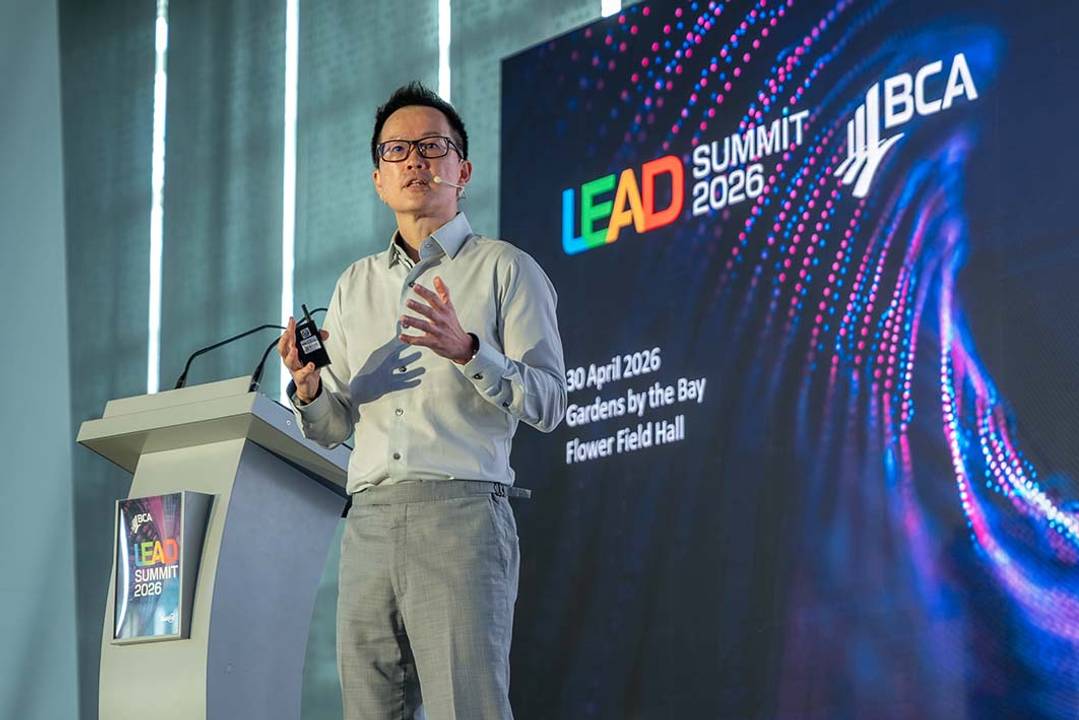

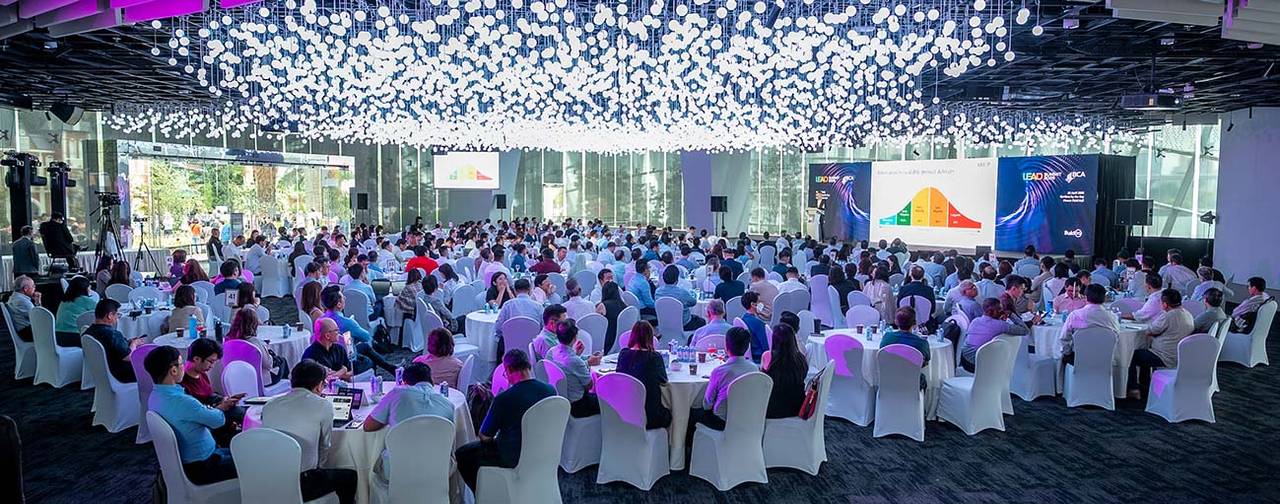
This year’s BuildSG LEAD (Leadership Engagement and Development) Summit took place on 30 April 2026 at Gardens by the Bay in Singapore, with the theme ‘Driving Value: Leadership in the Age of Intelligent Built Environment’. Organised by the Building and Construction Authority (BCA), the event is an annual flagship gathering and dialogue platform designed for built environment (BE) industry leaders.
In his opening address, Minister for National Development Chee Hong Tat announced several initiatives to help Singapore’s BE firms boost productivity further (read more here). BCA also presented its industry workplan for 2026, setting out key strategic priorities. Other speakers included leaders from Boustead Singapore, Arup, Lendlease and Google DeepMind.
Priority areas for Singapore
Singapore’s BE sector is expected to remain strong in 2026, supported by robust construction demand of S$47-$53 billion, nearly S$17 billion higher than pre-Covid levels. BCA’s new CEO, Derek Tan, outlined three focus areas for BE firms to develop a competitive advantage amid global geopolitical uncertainty and market volatility.
The first focus area is lean construction, which builds on the success of design for manufacturing and assembly (DfMA) and integrated digital delivery (IDD) methods to drive the next level of productivity savings. It is guided by “three core principles: maximise value and minimise waste, continuous improvement, and respect for people,” explained Mr Tan.
The design and construction of Ang Mo Kio station and tunnels under the Cross Island Line Phase 1 incorporated lean practices. Mr Tan shared that the project completed a critical traffic diversion milestone two weeks ahead of schedule and accelerated bore piling activities by 12 days, positively impacting project profitability and delivery certainty.
The second focus area is collaborative contracting. “We believe it can do a better job than lump-sum contracting, especially for large, complex projects,” he said. The framework facilitates risk-sharing and joint problem-solving and enables better management of disruptions and project delivery. As a result, it enhances coordination across the value chain, increases certainty on timelines and costs, and reduces disputes.
The LyndenWoods residential development on Science Park Drive was the first private-sector project to implement the NEC4 collaborative contract in Singapore. It has demonstrated equitable cost-sharing of risks through the extensive ERSS (earth retaining and stabilising structures) works required.
The third focus area is robotics, automation and AI, as Singapore seeks to strengthen capabilities and seize future opportunities arising from advancements in these fields. “Our past and ongoing efforts have built us a good foundation,” said Mr Tan.
The use of painting robots on the Parc Meadow @ Tengah public housing project – the first R&A (robotics and automation) fleet deployment by a painting subcontractor in Singapore – resulted in 50% manpower and productivity savings. One worker could manage two robots, compared to a current two-man painting team, and two robots were able to paint up to eight five-room units per day. This also helped achieve greater consistency in quality, improve the health and safety of workers, and attract more young talent.
‘Are we ready, or just following AI trends?’
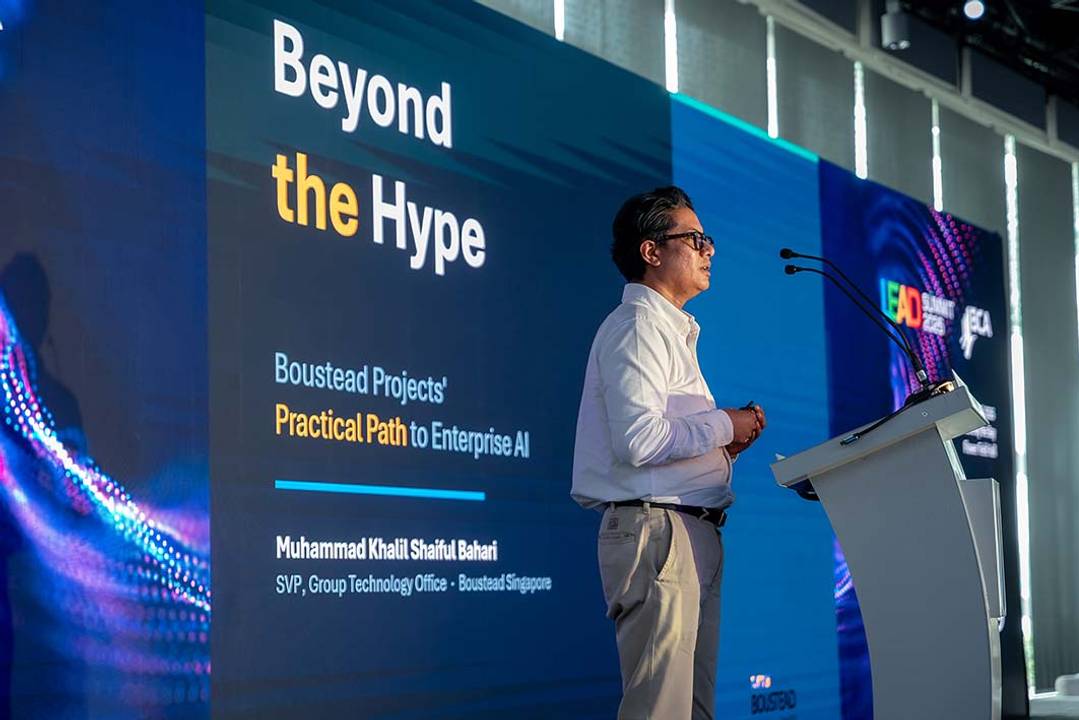
Muhammad Khalil Shaiful Bahari, senior vice president of group technology office at Boustead Singapore, shared the company’s AI journey from a contractor’s perspective, highlighting a practical, enterprise-led approach. With Singapore’s BE sector currently at an “inflection point,” he believes that “AI and robotics are a national economic necessity” that can tackle construction productivity challenges.
“We tried seven gen AI, or AI tools, across our projects in the last two years. Three are still running, while the other four taught us more about enterprise AI than any conference I’ve attended,” revealed Mr Bahari.
This experience has helped the company understand where the pitfalls are. “Are we ready, or are we just following AI trends?” asked Mr Bahari. He identified two types of failure: immature technology and unready organisations, with the latter being more common.
“AI fails because we keep skipping the foundation work,” he said. First, there is data chaos. “AI is a pattern-recognition engine that relies on clean, structured data,” yet the industry supplies it with fragmented files across emails, WhatsApp and various folders per project.
Workflow mismatch is another issue. “The most dangerous AI deployment is one inserted into a broken process, as it automates the dysfunction and scales it,” cautioned Mr Bahari. “So, fix the process first, then augment it with AI.” The third cause of failure is the people gap, since technology implementation is largely a change management challenge.
Reflecting on lessons from the AI journey, Mr Bahari emphasised the importance of “data before AI, and process before tools” – a principle that shapes Boustead’s decision framework. Some of the measures taken include developing a clean, ISO 19650-aligned common data environment (CDE) to provide the structured data required for AI, conducting a process audit to map every workflow AI will touch and eliminate bottlenecks before automation, and using an AI readiness scoring system.
Boustead has also established an AI governance policy. “We put in guardrails to ensure there’s no shadow AI working within the organisation,” said Mr Bahari, adding that by integrating AI responsibly, the company can protect both its own and its clients’ datasets.
Despite extensive AI application, human authority remains crucial for Boustead to ensure clear liability and accountability. “AI augments, but the PE still stamps. Every AI-assisted output carries a clear human review record. No AI model output goes to a client without a named engineer’s sign-off,” explained Mr Bahari.
For client transparency, each deliverable indicates what AI has and has not touched. “This is a trust-building asset, and clients have a right to know.” Boustead also mandates human review for any automation of safety-critical structural or fire compliance decisions, as the risk profile of construction does not allow otherwise.
Lastly, site culture. Mr Bahari pointed out that earning the trust of stakeholders on the ground is “the hardest and most important part of AI adoption in construction. Technology imposed from above without field buy-in will fail,” reinforcing the need for human engagement.
As Singapore’s construction firms move towards becoming AI-ready, he noted the urgency of growing the talent pipeline. “The built environment needs AI-native graduates now. Firms building student pipelines and SkillsFuture pathways today are building their 2028 workforce.”
In closing, Mr Bahari stressed that to realise the benefits of AI adoption, the industry should “stop celebrating pilots” and start “celebrating production deployments.”
Transforming BE value chain
Ramine Tinati, director of AI impact at Google DeepMind, gave the keynote presentation at the summit. He showcased the latest advancements in AI and discussed common barriers to adoption, as well as the technology’s potential to transform the entire BE value chain.
From financing, planning and design through to raw material selection, distribution, construction, and operations and maintenance, AI is a powerful tool. It can facilitate real-time fleet routing for site logistics, provide robotic solutions for on-site tasks, and detect PPE and edge hazards during construction.
The technology can also help predict the impact of weather on thermal performance prior to construction, support R&D in raw material formulation, and allow predictive maintenance of assets post-construction.
Mr Tinati further highlighted several factors that contribute to successful AI implementation, starting with data continuity. “AI is only as powerful as the data it feeds on, and disconnected silos cripple potential,” he said, asserting that “data standardisation is critical.”
The second factor is augmentation. “AI is a ‘co-pilot,’ not a replacement for human expertise.” The technology is intended to empower people to make faster and better decisions while keeping humans involved in final decision points.
Prioritising value is also key, added Mr Tinati. “AI adoption must solve specific, measurable business problems and translate them into real value, such as a better experience, cost savings, or optimisation.”
Other factors include interoperability and standards, with the need to “avoid proprietary ‘black box’ lock-in and ensure supply chain communication,” as well as security and trust, since “digital interconnectedness brings vulnerability to cyber threats.”
David Moran, principal of Asia Pacific digital services at Arup, shared the consultancy’s ‘total design’ approach, which integrates AI, parametric design and automated workflows into a unified delivery model that enables rapid iteration and cross-disciplinary optimisation.
In addition, Mr Moran presented Arup’s AI adoption framework, consisting of three pillars: productivity, core workflow and services.
The productivity pillar focuses on individual productivity and quality enhancement, aiming to deliver sustainable productivity gains and operating leverage for everyone. The services pillar explores new AI-powered products and services, creating scalable, higher-impact digitally enabled services.
The core workflow pillar is about differentiated design and engineering capability, resulting in lower cost, improved design quality and reduced delivery risk. This is often “the hardest pillar to work on,” said Mr Moran, as it is “where transformation is happening and where you’ve got that blend of people and process and technology.”
‘No success without the right people’
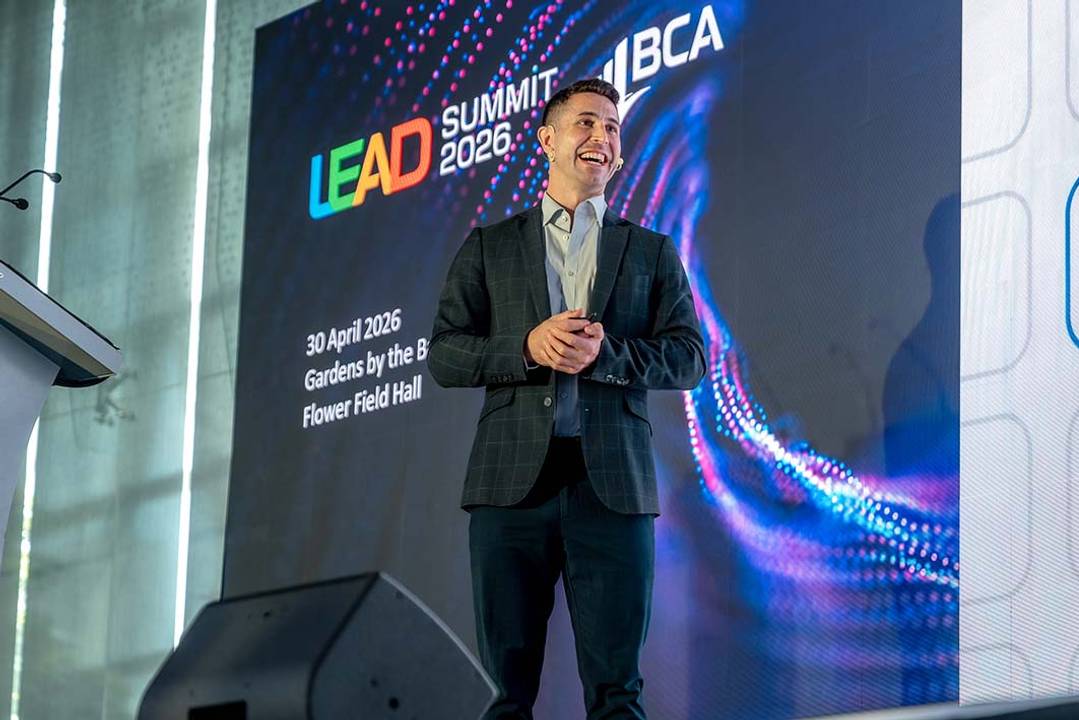
Matt Warren, head of digital at Lendlease, Europe, spoke about bridging the gap between design intent and built outcomes, as well as the essential role of leadership and organisational alignment in enabling transformation.
“I don’t believe in breaking down silos,” said Mr Warren, acknowledging that his view may be controversial. From an information perspective, he advocates building silos, as each contains a portion of the organisation’s knowledge. “Without the silo in the first place, it would be a mess.”
“We’re collecting our experience and putting it into that silo, then connecting our people to it,” he explained. By allowing them to access the data silo, they can draw on its wisdom to gain deeper insights and expand their knowledge.
On AI implementation, Mr Warren pointed out that “data comes first, AI is second,” a sentiment echoed throughout the summit. He said data should be “simple, standardised and siloed.”
However, collecting data will not be successful without “the right people leading it.” There are four main traits that Mr Warren sees as important in the teams and partners he works with.
The first is empathetic leadership. “Fear is the single biggest blocker to adoption. If you’re not empathetic, you can’t understand and break down the barriers that people put in front of you, so they will not engage with you. Empathy is everything.”
The second trait is diversity of thought, because “your DSLMs [domain-specific language models] will learn from you and the questions your team asks.” He mentioned that the models do not need to be large, but rather “specific, specialised and contained.”
“Collaboration goes without saying,” he added. “If you don’t collaborate, you won’t get there. Silos are critical, but siloed thinking is a disaster. Natural collaborators provide growth.” And the last trait is results-focused.
Wrapping up his talk, Mr Warren stressed that “the greatest risk to our industry is not AI; it is leaving our people behind. The best technology we can give them is the wisdom of the people who came before them.”
The summit also featured a panel discussion, which comprised Ar Kok Su-Ming, managing director of BCA Academy (moderator), Haresh Khoobchandani, vice president for APAC and Japan at Autodesk, Arup’s Mr Moran, Lendlease’s Mr Warren and Boustead’s Mr Bahari.
All images: War Studio (via BCA)