The Building and Construction Authority (BCA) and the Singapore Green Building Council (SGBC), with support from the Agency for Science, Technology and Research (A*STAR), have jointly developed the Built Environment Decarbonisation Technology Roadmap. Launched at the Urban Solutions and Sustainability (USS) Research & Innovation Congress 2026, held on 5-6 February, this roadmap adopts a ‘whole-life carbon’ approach, addressing both operational and embodied carbon emissions.
The roadmap will guide research and innovation efforts towards achieving the Singapore Green Building Masterplan’s (SGBMP)’s ‘80-80-80’ targets by 2030 and work towards the country’s longer-term target for net-zero emissions by 2050. Singapore is also committed to reducing its greenhouse gas emissions to about 45 to 50 mil t of CO2 equivalent (MtCO2e) by 2035, from the projected 60 MtCO2e in 2030.
Close to 70 key technologies and strategies are outlined in the roadmap. Market-ready solutions such as alternative cooling and ventilation technologies, AI-controlled energy optimisation systems, and low-carbon construction practices will help developers and building owners decarbonise their building portfolios, while identified emerging technology priorities will support Singapore’s Research, Innovation and Enterprise (RIE) 2030 plan.
Since January 2025, BCA and SGBC have engaged about 100 built environment (BE) stakeholders – including building owners, consultants, Institutes of Higher Learning (IHLs), material suppliers and technology solution providers – to co-create this latest roadmap, which replaces the 2018 Super Low Energy Building Technology Roadmap.
In the new roadmap, BCA and SGBC state that “due to our early emphasis on energy efficiency measures since 2005 via the Green Mark scheme and the Singapore Green Building Masterplans, operational carbon is expected to decline with increasing energy efficiency and the adoption of renewable energy.
“As operational carbon is reduced, embodied carbon will grow in importance as a proportion of total emissions. Upfront carbon, which refers to carbon emissions during materials production and construction phases of the life cycle before the building or infrastructure begins operating, has the potential to account for up to half of the entire carbon footprint of new construction between now and 2050. Hence, it is important for us to pay more attention to embodied carbon.”
Empowering BE firms
Tan Chee Kiat, deputy CEO for industry development at BCA, shared several initiatives to help businesses reduce their whole-life carbon emissions by leveraging potential synergies and accelerating cross-value-chain collaboration.
“These include developing an industry tool for carbon calculation, initiatives under Green Mark and GreenGov.SG, as well as grants to support energy efficiency in construction and the pursuit of research and innovation (R&I) in these areas,” said Mr Tan.
BCA had worked with JTC, NUS-ESI and SGBC to develop an industry tool for carbon calculation in buildings. This is available as open-source data for industry use on the SGBC website.
Under its Green Mark Scheme, BCA has also introduced the Whole Life Carbon section, which holistically evaluates projects on their carbon footprint throughout the building’s lifecycle. Firms demonstrating exceptional performance are eligible for the Whole Life Carbon badge.
In addition, through the GreenGov.SG initiative, up to 5% of overall tender evaluation points has been set aside for Government Procurement Entities (GPEs) to incorporate sustainability considerations in large public construction tenders with estimated contract value above S$50 million. This allows firms with demonstrated green construction practices to be recognised and awarded additional points as part of the tender evaluation process.
Meanwhile, the Energy Efficiency Grant (EEG) encourages the use of energy-efficient equipment during construction. The scheme provides two tiers of support: Base Tier (up to S$30,000 per firm) based on the pre-approved list of equipment, and Advanced Tier (up to S$350,000 per firm) for those seeking to make a greater impact in driving low-carbon construction.
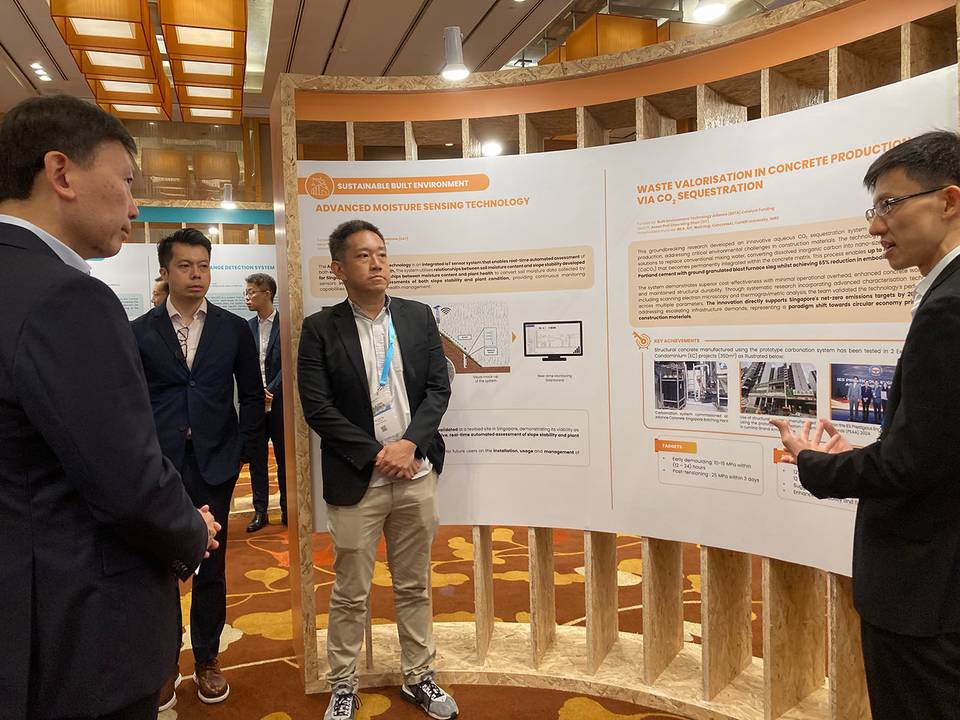
Mr Tan further pointed out that BCA actively supports firms in pursuing industry-driven R&I through various RIE programmes, covering areas that include embodied carbon as well. One such example is the development of an ultra-low-carbon concrete under the BETA Catalyst Funding programme, involving an alliance of stakeholders such as SIT, Woh Hup and ConcreteAI, which enables up to 80% cement replacement, resulting in a reduction of embodied carbon by up to 65%.
Now that the roadmap provides the industry with a clearer path towards a sustainable future, stakeholders can take more decisive action. BCA and SGBC highlighted that “technology plays a key role in the transition to encourage the switch to low-carbon alternatives and drive transformational change.”
Download the full report here.